Prevent Summer Learning Loss: Simple Strategies to Keep Kids Learning
Originally published at brighterly.com

Summer learning loss is a decline in kids’ academic skills and knowledge that happens during summer break due to children going without regular learning practice. You can help your kid avoid this decline by using expert-backed strategies, ranging from simple daily reading and use of worksheets to taking trips and joining summer camps.
How Much Time per Day Does It Take to Prevent Summer Learning Loss?
The average minimum time that is enough to prevent summer slide or learning loss is 20 minutes of structured learning practice per day, at least 5 days a week. However, this doesn’t apply to kids in grades K-2, when learning should be based on conversations and explanations rather than on independent practice.
Backing up the minimum study time data, Dr. Emily Levy, a Founder and Director of EBL Coaching at EBL Coaching says:
“During the summer, students should do academic work for at least 20 minutes per day, ideally every day, but at a minimum, 5 days per week.”
This work should include a combination of reading, writing, and math skills.
And while agreeing with the 20 minutes minimum per day learning duration, Claire Smizer, Brighterly Educational Advisor, adds about how it’s different for younger kids, using reading practice as an example:
“The ’20 minutes of independent reading’ advice applies to older kids who already decode.”
For the youngest learners, the work is conversation and exposure. Read everything. Read it out loud. Talk about what it means.
Essentially, devoting roughly 20 minutes a day to learning can be enough to help your kid avoid forgetting roughly 17-34% of school material in summer, which is the estimated learning loss percentage for kids in grades 1-8, according to the most recent NWEA MAP Growth report covering this issue for July 2020.
How to Prevent Summer Learning Loss: 10 Strategies at a Glance
| Method | Best For | Average Time Per Day |
| 1. Work With a Tutor | Struggling or advanced students | 45 min/session |
| 2. Use Worksheets & Practice Tests | Quick practice/diagnostics | 20 min/day |
| 3. Join a Summer Camp | Social learners | Program-scheduled |
| 4. Get Creative with Activities | Kids who resist formal study | 20–30 min/day |
| 5. Take Educational Trips | Curious, hands-on learners | As long as trips allow |
| 6. Set Clear Learning Goals | Goal-oriented learners | 5 min planning + 20 min daily practice |
| 7. Use Educational Technology | Tech-loving kids | 20–30 min/day |
| 8. Turn Hobbies into Learning | Passion-driven learners | As long as hobby time |
| 9. Volunteer as a Family | Value-centred families | 1–2 hrs/week |
| 10. Read Every Day | All ages, all learning styles and levels | 20 min/day |
1. Work With a Tutor Over the Summer
Best for: Students who struggled during the school year or did great and want to retain their knowledge and learn more.
One of the solutions for preventing summer learning loss is hiring an online or offline tutor — a skilled professional in a particular subject. A tutor provides the structure and accountability that the kids usually lack in summer due to not attending scheduled classes and having no homework.
Speaking on the importance of structure for a child’s brain, Claire Smizer, Brighterly Educational Advisor, also advises adding something predictable to a child’s summer routine:
“A summer that’s pure unstructured time can feel like a vacation in June and a regression by August.”
The fix isn’t a rigid 9-to-5 academic schedule. It’s a loose rhythm: a predictable morning, some quiet time for reading or a project, time outside, time for play, maybe one ‘thinking’ activity a day.
Apart from someone who provides structure, a professional tutor is also someone who is inherently interested in your child’s progress. To ensure this progress, private educators usually create highly personalized and focused study programs. If needed, they may also incorporate games, quests, and challenges to make learning more fun. That’s the answer to all those who fear turning their kids’ holidays into a constant academic marathon.
For example, our summer learning loss tutors at Brighterly build a learning process in a game-like way to make it fun for the students. We have an online math program and an online reading program for kids in grades K-12, where our professionals teach your kid in a one-on-one format.
Both math and reading programs align with the U.S standards, but our tutors tailor the curriculum according to your kid’s learning style, level of knowledge, and summer learning goals.
2. Use Worksheets and Practice Tests
Best for: Learners who like quick, structured tasks.
By regularly completing worksheets that take around 20 minutes on average, children reinforce what they already know and stay mentally engaged, which helps them effectively avoid summer learning loss.
Spending the same 20 minutes on practice tests can help a child perform a quick knowledge check and assess their current performance easily. When they see incorrect answers, they know what topic or concept they need to pay extra attention to.
If you think just 20 minutes may not be enough, Kaitlynn Blyth, Founder & CEO of Happy Day Play, Inc., says “Twenty minutes a day is plenty”, clarifying that consistency is what really matters in learning:
“The mistake a lot of parents make is assuming more equals better, when consistency is what actually holds learning in place across the summer.”
A child who reads ten minutes every single day retains more than one who crams a workbook in August.
Free Brighterly Worksheets to Try This Summer
We have both tests and worksheets on our website that you can access for free. The theoretical section has a lot of materials and can be great for summer knowledge revisions, while knowledge-checking tests help assess how well a child remembers specific materials. And our math worksheets have plenty of math tasks that you can do online or print for extra practice and convenience.
3. Join a Summer Camp
Best for: Kids who like a social element in learning.
Summer camps introduce a strong social element to learning. They promote teamwork, communication, and problem-solving, while letting kids have fun through gamified experiences. In summer camps, your child can not only learn and grow academically, but also find new friends.
Apart from socialization and fun experiences, summer camps with special summer programs can provide another important thing — a daily learning routine. And consistency in learning is one of the most reliable factors against summer brain drain.
With camps, you don’t have to worry about inconsistency — the camps have programs and schedules that kids follow. For example, our summer math camp and summer reading camp run online, which means a child can have scheduled lessons and consistent study time even without disrupting your family’s summer plans.
In addition, AERA July 2022 research data proves that summer camps effectively help students maintain their past knowledge and make academic progress. In some regards, camps are even better than traditional classrooms, as they blend learning with fun activities, keeping kids mentally active without the pressure of scores.
4. Get Creative with Learning Activities
Best for: Kids who don’t like traditional, formal learning experiences but enjoy learning with a creative element.
Effective learning can happen even when kids are having fun and are not aware they are learning at all. To help your child enjoy learning, you can take creative, fun activities your kid already loves and build learning around the academic skills hiding inside these activities.
Creative Activities That Keep Kids Learning
Examples of activities you can offer your kid to make their learning engaging and fun include storytelling (for working on writing and reading skills), arts and crafts (for working on motor skills), science experiments (for refreshing science-related knowledge), and educational games (for refreshing knowledge across different subjects).
- Storytelling is what helps kids fall in love with writing and reading, while also enhancing vocabulary memorization and creative thinking.
- Arts and crafts activities help kids develop fine motor skills, while also letting children express themselves and relieve stress.
- Science experiments can help kids refresh science-related past knowledge and build new ones on it.
- Educational games for refreshing knowledge can be built around different subjects and are always conducted in groups, which makes them ideal options for quality family activities or friend time.
Just like camps, creative activities help kids perceive learning as an enjoyable process, while also helping them build confidence, develop curiosity and independence.
5. Take Educational Trips
Best for: Curious, hands-on learners who prefer real-life-based learning to traditional classrooms.
Museums, science centers, historical landmarks, or nature parks are all great knowledge reserves where you can take your kid for an educational trip to help them grasp new facts, ideas, and perspectives. Additionally, visiting such places is practical for improving memory retention — when kids actually see and feel what they have to learn, they understand and remember it much more easily.
This method of summer learning loss prevention is also a great way of spending quality family time. For example, Helen Neale, Therapeutic Counsellor and Parenting and Neurodivergence Expert at KiddyCharts, shares how such educational trips can help with both studying and family bonding:
“Educational trips are definitely the way to go – and they can be totally free.”
Just get the kids out enjoying the sunshine. My Dad taught me about wildlife on our photography walks – I now know a shed load of names for all the common butterflies out there in the UK.
To see how important educational trips are, you can look at the COVID-19 times. It was a period of limited trips and interactions, and also the time when school education struggled significantly. That’s when a new condition, known as pandemic learning loss, emerged. Limited social contact, no new impressions, and a lack of real-world interactions — all these factors combined to cause children to forget their past academic gains.
6. Set Clear Learning Goals for the Summer
Best for: Kids who do better at learning when they have clear goals they’re trying to reach.
Set clear study plans and goals for your child to follow so that the summer months don’t just pass by with the best intentions but no real progress. Make sure that these plans and goals are very specific, not something vague like “get better at math” or “improve reading”. For example, if you want your child to stop summer learning loss through reading, make sure to discuss and agree with them on an exact number of books they’ll need to read during the school break. You can break the task even further and turn it into a fun competition. For example, you can establish prizes for each book or chapter read to keep your child more motivated to move on.
If your kid doesn’t like reading, try to make this habit more attractive and even inevitable to follow. Create an encouraging environment to make reading a cool and consistent habit. Also, think of the perfect moment in your summer schedule to open a book together.
That’s the key recommendation on this point from Neeru Khosla, the Creator of CK-12 educational platform:
“Make reading enjoyable and accessible.”
Let children self-select text, create cozy reading spaces, and make books available. Have them set a reading goal or get involved in a local reading “competition” from libraries. Also, there are lots of summer camps focused on practicing reading along with writing, math, and creativity skills.
After setting the goal and planning everything, remember to support your kid even if they struggle while trying to reach this goal. The process matters even more than the end result. That’s what Daniela McElhaney, Head of Ivybrook Academy, also believes in:
“It also helps to pay attention to the process rather than the outcome.”
Instead of commenting on whether an answer is right or wrong, notice the thinking, effort, and persistence behind it.
7. Use Educational Technology
Best for: Kids who love technology.
To prevent a tech-loving kid from summer loss of learning, you can ask them to practice with interactive apps, online platforms, coding games, or virtual field trips. The best thing about all these tools is that they easily adjust to the kid’s current level and offer personalized practice.
You can also implement all those tech tools from an early age, when your kid starts using gadgets. Plus, all these tools can foster digital literacy, creativity, independent learning habits, and allow your child to learn anytime, anywhere, whether on vacation or in a car.
However, don’t forget to manage screen time carefully so that the technology supplements the outdoor play, reading, and other summer activities rather than replaces them. Also, make sure technology is used for learning, not just to fill the time.
To make sure your kid has a structured experience with tech-based learning, you can try looking for a special educational online platform that offers a scheduled program with short 15-30 minute sessions, so you can control how much your child spends there.
8. Turn Hobbies into Learning Opportunities
Best for: Kids who are motivated by what they’re passionate about.
According to the article published in the Reading and Writing journal in March 2020, writing is one of the subjects suffering the most during the summer holiday period. The authors also highlight that seeking activities that are creative and appealing to a child, such as journaling, storytelling, or blogging, is most effective in overcoming the struggle.
The same approach applies to any other subject. For example, cooking, specific board games, and LEGO challenges can all be used to learn something.
- Cooking teaches measurement skills, fractions, and the following multi-step instructions in a specific sequence.
- Building with LEGO teaches spatial reasoning and basic engineering thinking.
- Playing chess develops strategic planning and pattern recognition.
The key is noticing what your child loves to do and using this activity to teach them something new or reinforce knowledge they already have. Plus, including favorite activities in learning shows the child how book knowledge applies to real life.
9. Volunteer as a Family
Best for: Low-income students and kids from socially active families who value their social impact.
Volunteering may seem like an unusual strategy for stopping summer learning loss, partly since the learning feels invisible. However, when kids help at a food bank, animal shelter, community garden, or a local library, they practise authentic reading and math skills when reading safety instructions, measuring ingredients or quantities, writing notes, tracking numbers, etc. So, even though volunteering is not a formal or traditional form of learning, it can still help reinforce the academic skills built during the school year.
Additionally, volunteering can help kids develop a sense of community. Just like summer camp, it implies communication and cooperation, offering a chance to make new friends. But two things are different between the two activity types — volunteering is completely free of charge and offers a feeling of being a valuable member of society.
You can start from your local library — many run volunteer programmes for children and teens over the summer, often linked to their free summer programs. As for food banks, animal shelters, and community gardens, they usually welcome family teams for shorter, single-day shifts, which can involve your whole family, rather than being a solo activity for the child.
10. Read Every Day
Best for: Kids who love reading.
If your goal is to target summer reading loss specifically, reading every day is the best strategy. However, reading not only improves reading skills and reading comprehension, but also helps build vocabulary and develop critical thinking — skills paramount for steady progress in practically any knowledge field, from math to the arts. Once kids develop a strong reading habit, they can explore specific topics they like, at their own pace and without external motivation.
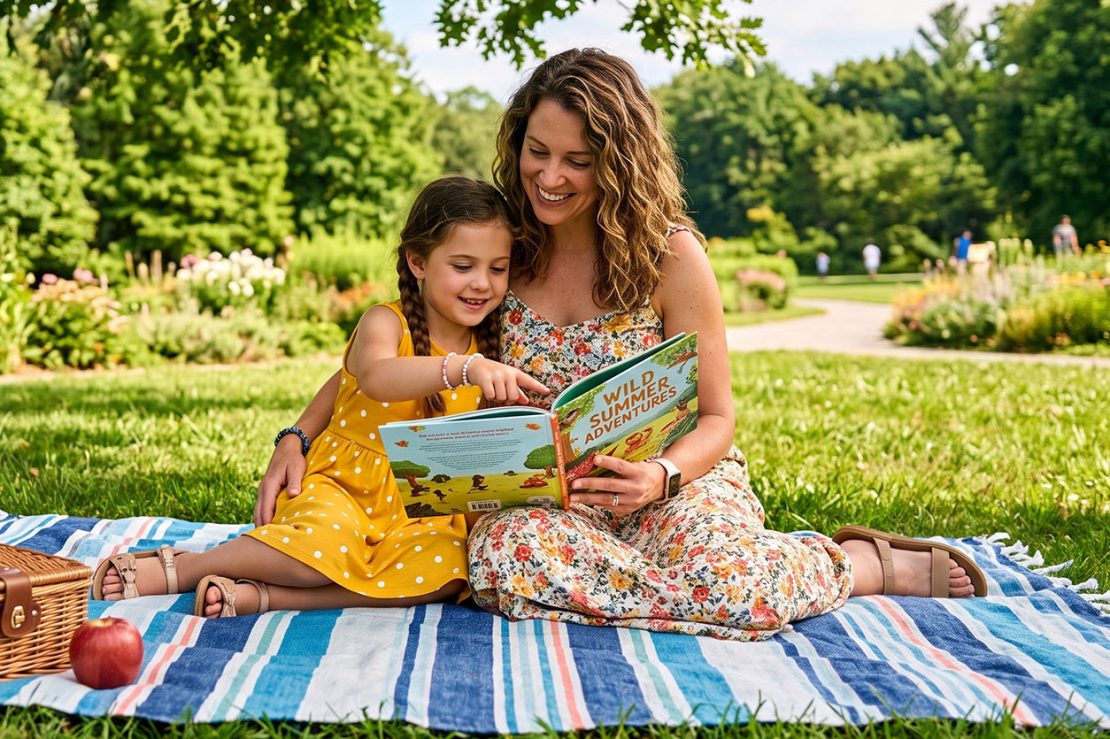
Even if your kid can’t read on their own, you can incorporate this activity into your daily routine. Dr. Emily Levy, Founder and Director of EBL Coaching at EBL Coaching shares how:
“For reading, they should either read independently or, if they are unable to read, have a parent or another adult read to them and ask them questions about the story, plot, and characters.”
For writing, kids can write in a journal about their daily activities or do everyday writing tasks, like writing out a grocery list or a list of activities they want to do on vacation.
Also remember that all reading counts. Graphic novels, digital texts, magazines, audiobooks, well-written game narratives, and even life-related things like simple manuals or recipes all add to the child’s reading volume.
For example, Kaitlynn Blyth, Founder & CEO of Happy Day Play, Inc., advises reading whatever your child is curious about in their surrounding:
“I tell families to start with and protect a few small habits.”
>Read together every day, talk through one real-world problem (like splitting a recipe during dinner time or reading the map at an amusement park), and let your child lead something they’re curious about.
Another option to encourage consistent reading is to get your kid into one of the summer reading programs, most of which offer rewards.
Conclusion
Preventing summer learning loss doesn’t have to mean turning the school break into a continuation of the school year. The right strategy depends entirely on your child — with a hands-on learner, you can try educational trips and science experiments, while with a social kid, summer camps and family volunteering can be good options.
For tech-savvy kids, you can offer educational apps and interactive platforms, while if your child is a passionate reader, encourage this practice and join them. And for kids who need more guided learning support, struggled during the school year, or want to stay ahead, working with a tutor can be an option.
Whatever strategy you choose, remember that consistency beats intensity. Just around 20 minutes a day the whole summer is enough to avoid losing the knowledge received during the school year and even learn something new.
Frequently Asked Questions
What Are the Different Types of Summer Learning Loss?
Summer learning loss can be divided into three main types: math skill loss (forgetting math facts, multiplication tables, etc), reading skill loss (reduced reading speed, comprehension, and vocabulary), and motivational loss (losing the learning habits built during the school year).
According to NWEA April 2026 data, math and reading skills are the ones kids lose the most in the summer.
Can Summer Learning Loss Be Fully Recovered Once School Starts?
Yes, most students can recover learning skills they’ve lost during the summer within the first few months of the new school year. However, it all depends on how much knowledge the child has lost and how much the child is invested in regaining this knowledge. Essentially, the earlier families notice and address summer learning loss, the bigger chance of recovery the child has.
Does Summer Learning Loss Get Worse as Kids Get Older?
There is no clear data proving that summer learning loss gets worse as the kids get older. For example, NWEA April 2026 data show that summer slide usually happens in grades 3–8 on average, but point out there are other factors (like income and race) that influence learning loss in different students.
Do Summer Homework Packets Actually Help?
Summer homework packets can help with summer learning loss, but it all depends on whether a child actually completes the packets throughout the course of summer, whether the packet’s content matches the child’s current knowledge level, and whether the parent is involved to guide a kid if necessary.