What Is Dyscalculia? Signs, Symptoms & Treatment for Children
If your child experiences persistent difficulties with math despite putting forth significant effort, it may indicate an underlying issue beyond ordinary math challenges. They may have dyscalculia, a specific learning disability that affects a student’s ability to grasp numbers and math concepts.
By learning more about dyscalculia, you can identify early signs and seek intervention for your child. With the right specialized instruction, students with dyscalculia can improve their math skills and become much more confident in their abilities.
Students with dyscalculia often benefit from specialized instruction. If you are seeking dyscalculia tutoring in NYC, working with a tutor who understands learning disabilities can make a significant difference in your child’s progress.
Learn more about finding the right support in our guide to special education tutoring at Special Education Tutoring Near Me: How to Find the Right Tutor – EBL Coaching.
What Is Dyscalculia?
Dyscalculia is a learning disability that affects a student’s ability to understand numbers, develop fluency with math facts, perform math calculations, and solve word problems. It is sometimes called “math dyslexia,” but it is very different from dyslexia, which affects reading and writing.
Children with dyscalculia often struggle with number sense, or the understanding of how numbers work and relate to one another. Struggling with number sense can make solving math problems more challenging.
Dyscalculia is considered a specific learning disorder in mathematics and is unrelated to a student’s intellect or capabilities.
What Causes Dyscalculia?
Research indicates that dyscalculia is related to differences in how one’s brain processes numerical information. It can be genetic, like dyslexia, often running in families.
Dyscalculia is not caused by:
- Poor effort
- Low intelligence
- Lack of motivation
Students with dyscalculia are often bright and excel at other academic skills, including reading and writing. They may also be creative and artistically talented.
Signs and Symptoms of Dyscalculia in Children
The signs of dyscalculia can vary by student. However, some common signs include:
Trouble Learning Basic Math Facts
Students with dyscalculia may struggle to learn and become fluent in addition, subtraction, multiplication, and division facts even after extensive practice.
Poor Number Sense
Students might have poor number sense, including trouble understanding which number is greater, estimating quantities, or recognizing numerical patterns.
Difficulty Counting
Some students with dyscalculia may skip numbers, lose track when counting, or have trouble counting backwards.
Trouble Solving Word Problems
Word problems require students to move from language to arithmetic and back to language. This multi-step process can be very challenging for students with dyscalculia.
Difficulty Understanding Time and Money
Students with dyscalculia may have difficulty telling time, calculating change, understanding schedules, or estimating how long a task might take to complete.
Trouble Learning Math Procedures
Math problems with multiple steps, including multi-digit multiplication, long division, adding fractions, and solving algebraic problems can be particularly challenging for students with dyscalculia.
Math Anxiety
When a child struggles consistently with math, they may develop low self-esteem, increased frustration, and anxiety surrounding math.
Signs of Dyscalculia by Age
What are signs of dyscalculia by age?
Preschool
- Difficulty recognizing numbers
- Trouble learning to count
- Struggles with understanding quantities
- Challenges sorting objects
Elementary School
- Trouble developing fluency with math facts
- Difficulty understanding place value
- Challenges with solving math word problems
- Struggles with multiplication and division
Middle School and High School
- Difficulty understanding fractions, decimals, and percentages
- Struggles with solving algebraic equations
- Difficulty estimating time
- Avoidance of math tasks
Dyscalculia vs. Math Anxiety
Dyscalculia and math anxiety can look similar, but they are actually very different issues.
Math anxiety is an emotional reaction that leads to stress and fear when faced with math-related tasks. Dyscalculia is a specific learning disability that affects one’s ability to process and understand math.
Students with dyscalculia often develop math anxiety after extensive challenges with math. Oftentimes, both issues occur together.
Dyscalculia vs. Dyslexia
Dyscalculia and dyslexia are both learning disabilities, but they affect different skill areas.
Dyslexia affects reading, spelling, and writing, while dyscalculia affects math, including number sense, math reasoning, and math calculations.
Some students have both dyslexia and dyscalculia, while others have just one of these disabilities.
How Is Dyscalculia Diagnosed?
Dyscalculia is typically diagnosed through a comprehensive evaluation competed by a trained professional.
This comprehensive evaluation may assess:
- Math reasoning abilities
- Calculation skills
- Number sense
- Working memory
- Processing speed
- Executive functioning
Through this evaluation, the evaluator can determine if the student has dyscalculia. Parents in New York City who suspect their child may have dyscalculia often begin with a psychoeducational or neuropsychological evaluation to better understand their child’s math skills, academic profile, and overall educational needs.
Following a dyscalculia diagnosis, many parents seek specialized dyscalculia tutoring in NYC to develop skills including number sense, math reasoning, and problem solving. Early intervention can help students build stronger foundational math skills and improve their performance at school.
How to Help a Child with Dyscalculia
Dyscalculia never “goes away”, but specialized instruction can help students make significant improvements in their math skills.
Effective dyscalculia tutoring often includes:
Multi-sensory Math Instruction
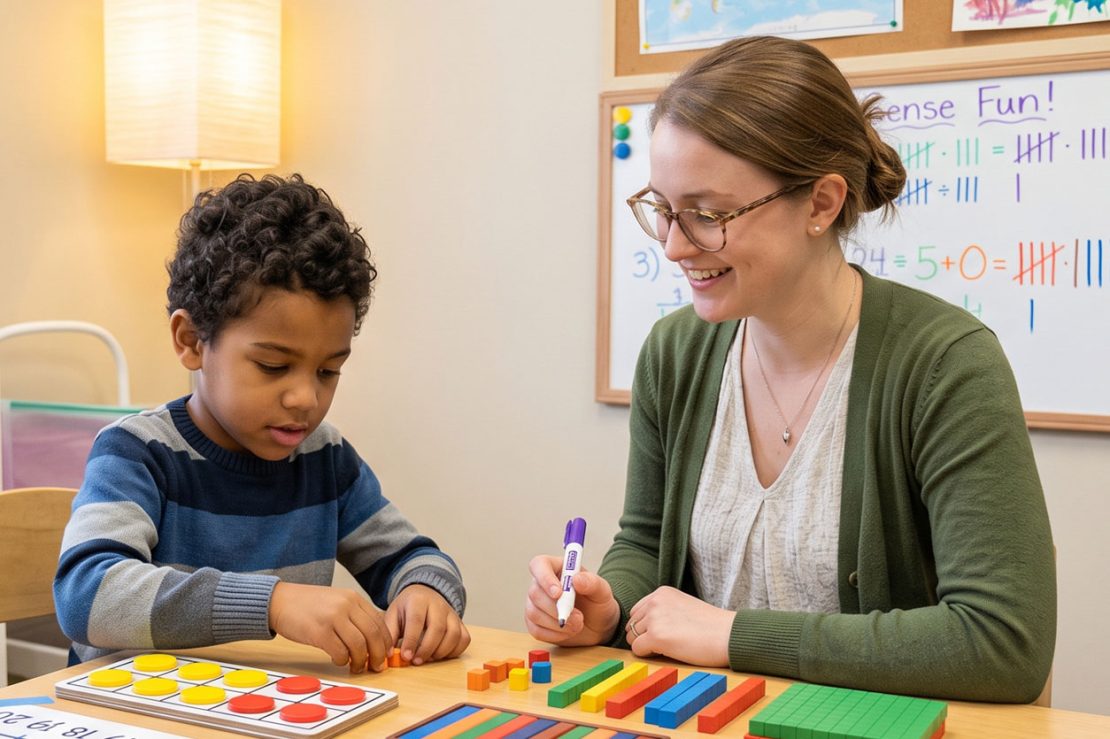
A multi-sensory approach, which integrates the visual, auditory, and tactile/kinesthetic modalities, helps students with dyscalculia build a stronger understanding of math concepts.
Explicit Teaching
When tutoring a child with dyscalculia, concepts should be taught directly and systematically with clear explanations. Students should also be given ample practice with each concept before moving onto new ones.
Manipulatives
Math manipulatives, including number lines, counters, base-ten blocks, and fraction models, help make abstract concepts more concrete and easier to understand for students with dyscalculia.
Individualized Tutoring
One-on-one tutoring using research-based, multi-sensory techniques that is customized to the specific areas of difficulty for a child with dyscalculia is key. An initial evaluation prior to the start of tutoring can help identify which aspects of math the child needs the most help with. For students in New York City, individualized dyscalculia tutoring can provide customized support that they may not receive in a traditional classroom setting.
Developing Number Sense
Effective math tutoring programs should focus on helping students understand relationships between numbers, not just memorizing procedures for solving problems.
When evaluating tutoring options, it’s important to ask about a tutor’s experience working with students who have learning disabilities. See our guide on questions to ask before hiring a tutor at What Questions Should You Ask Before Hiring a Tutor in NYC? – EBL Coaching.
Can Students with Dyscalculia Succeed in School?
Yes! Students with dyscalculia can absolutely succeed in school.
Many highly successful adults have learning disabilities, including dyscalculia. With specialized tutoring, appropriate accommodations, and research-based instruction, students with dyscalculia can make significant progress in their math skills and develop stronger confidence in their abilities.
It is important to recognize the signs early and identify the right specialized tutoring for your child to help them thrive.
Where to Get Help for Dyscalculia
If your child is showing continued math difficulties despite consistent effort, they may have dyscalculia. Early intervention with the right math support can make a big difference.
At EBL Coaching, we provide specialized dyscalculia tutoring in NYC using evidence-based, multi-sensory instructional methods. Our individualized math tutoring program helps students strengthen their foundational math skills and achieve greater success in school.
Dyscalculia Tutoring in NYC
Students with dyscalculia typically respond well to specialized, one-on-one tutoring that targets number sense, math reasoning, math facts, and problem-solving skills. Unlike traditional tutoring or homework help, dyscalculia tutoring should use research-based, multi-sensory instructional methods customized to each student’s specific needs.
If you are seeking dyscalculia tutoring in NYC, you should look for tutors with experience working with students who have learning disabilities and who use evidence-based math intervention techniques.
At EBL Coaching, we specialize in providing research-based, multi-sensory math tutoring designed to help students with dyscalculia build their core math skills, improve their confidence, and achieve academic success.
Learn more about our private tutoring Services in NYC at How to Find the Best Private Tutor in NYC for Your Child – EBL Coaching.
FAQs About Dyscalculia
What are the main challenges associated with dyscalculia?
The main challenges associated with dyscalculia are difficulties with understanding numbers and math concepts. Students with dyscalculia often struggle with learning math facts, number sense, and word problem solving.
Is dyscalculia a form of dyslexia?
No. Dyscalculia and dyslexia are different learning disabilities. Dyslexia affects reading and writing skills, while dyscalculia affects math skills. Students with both dyslexia and dyscalculia, however, tend to respond well to a multi-sensory approach to teaching.
Can dyscalculia be cured?
Dyscalculia cannot be cured, but specialized tutoring can significantly improve a student’s math skills and overall performance at school.
How common is dyscalculia?
Research indicates that dyscalculia affects approximately 3% to 7% of the population.
Can a child be gifted and have dyscalculia?
Yes! Dyscalculia is unrelated to intelligence. In fact, many students with dyscalculia have above-average intelligence and excel in many other skills, including reading, writing, science, and art.
Does ADHD cause dyscalculia?
No, ADHD doesn’t cause dyscalculia. However, ADHD and dyscalculia can occur together. Students with ADHD often have attention and executive functioning challenges, which can impact their math learning.
Students with ADHD often have attention and executive functioning skills challenges that can impact math learning at What Are Executive Functioning Skills? A Simple Guide for Parents – EBL Coaching.
What type of tutoring helps students with dyscalculia?
Students with dyscalculia typically benefit from one-on-one, multi-sensory math tutoring tailored to their specific areas of weakness. Families seeking dyscalculia tutoring in NYC should look for tutors who have experience working with students with learning disabilities and who use evidence-based instructional approaches.
Where can I find dyscalculia tutoring in NYC?
When looking for dyscalculia tutoring in NYC, try to find a tutor who has experience working with students with learning disabilities and who uses evidence-based, multi-sensory instructional methods for the tutoring sessions. Effective dyscalculia tutoring should focus on developing number sense, strengthening math reasoning skills, building fluency with math facts, and teaching strategies for solving multi-step math problems.
Dr. Emily Levy, the founder and director of EBL Coaching, has helped thousands of students in New York City develop their math skills through specialized tutoring programs over the past twenty years. She is the author of the Strategies for Study Success student workbook series, the Flags and Stars Orton Gillingham student workbook program, and the Flags and Stars Multi-Sensory Math student workbook series. She speaks nationally at educational conferences and frequently appears on podcasts as an educational expert. She has also been featured in publications including Newsweek, Autism Advocate Parenting Magazine, Epoch Times, and Macaroni Kids.